
What Causes Paint Peeling and
How Silicate Paint Solves It for Good
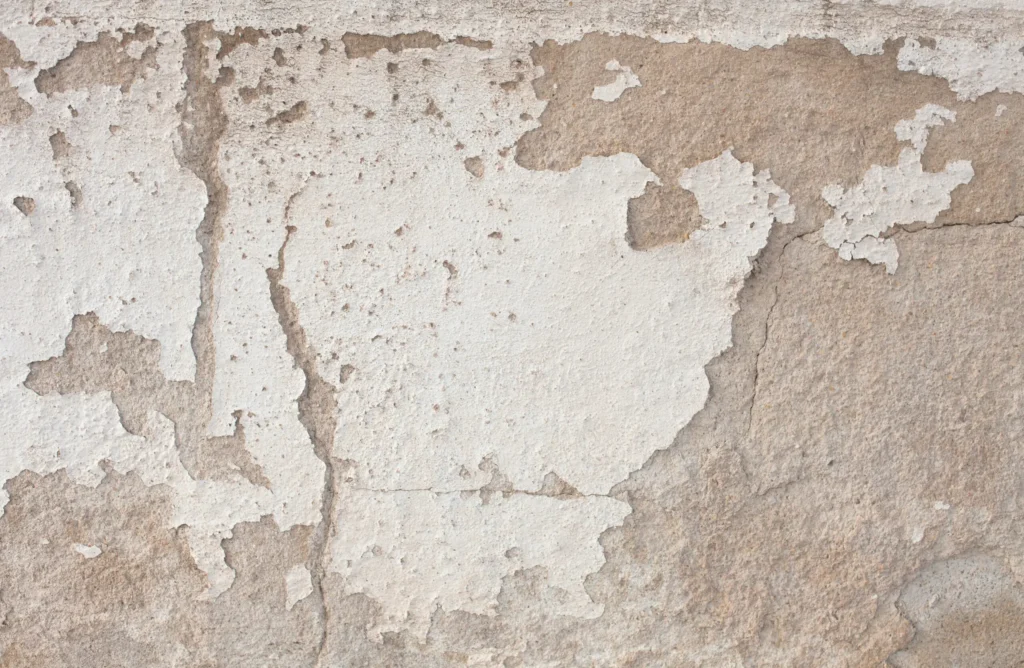
For architects, interior designers, and homeowners investing their hearts into creating a building, few things are as frustrating as seeing paint blister, fade, and peel off in sheets just a few years after handover.
Beyond ruining the aesthetic value of a structure, paint failure is a warning sign that the underlying concrete is suffering from moisture distress and environmental aggression. Left unaddressed, it leads to escalating maintenance costs and repeat repairs.
Repainting over damage or using temporary wall putty only treats the symptoms. To solve the issue permanently, we must look at the material science behind paint failure and understand why Pure Silicate Paint (Mineral Paint) has become a game-changing solution in modern architecture.
1. The Science Behind Paint Failure: 4 Main Causes
Paint peeling is often blamed on poor workmanship or over-diluting paint with water. However, material science reveals that paint failure is caused by physical and chemical stresses occurring between the paint film and the concrete substrate.
A. The Moisture Trap and Vapor Pressure
In tropical and high-humidity climates, moisture penetrates concrete walls from multiple sources:
-
Rising Damp: Groundwater drawn upward through the foundations via capillary action.
-
Rainwater Penetration: Rain seeping into hairline cracks in the plaster.
-
Construction Moisture: Trapped water inside newly poured concrete that hasn’t cured completely.
Traditional acrylic paints rely on synthetic binders that act like a sheet of plastic over the wall. When the sun heats the exterior wall, trapped moisture turns into vapor and expands. Because the plastic film is non-permeable, rising vapor pressure pushes against the film, causing it to blister, tear, and peel off in sheets.
B. UV Degradation of Polymers
Acrylic paints adhere to walls via physical bonding—much like placing sticky tape or plastic wrap on a surface. Over time, high levels of ultraviolet (UV) radiation break down the carbon bonds in the acrylic polymers. As the adhesive binder degrades, the paint chalks, loses its grip, and easily washes away under wind and rain.
C. Alkali Attack (Saponification)
Fresh concrete and wet masonry have a high alkaline pH level (pH 12–13). This alkalinity attacks the organic resins in standard acrylic paints through a chemical process called saponification. This breaks down the film’s chemical structure, causing discoloration, efflorescence (salt crusts), and severe peeling if alkali-resistant primers are not applied thickly enough.
D. Surface Contamination
Dust from sanding, oil from formwork release agents, or mold spores on uncleaned walls prevent acrylic film from directly touching the masonry. The paint sticks to the surface dust instead of the wall, leading to early delamination.
2. Acrylic Paint vs. Pure Silicate Paint: Technical Comparison
| Feature | Acrylic / Emulsion Paint | Pure Silicate Paint |
| Material Base | Organic Petrochemicals | Inorganic Natural Minerals |
| Surface Structure | Continuous Plastic Film | Open Micro-porous Honeycomb |
| Bonding Mechanism | Physical Adhesion (Like Tape) | Chemical Fusion (Petrification) |
| Vapor Permeability | Low (Traps Moisture) | High (SD-Value < 0.02 m) |
| UV Resistance | Polymer chains break down | Highly stable mineral bonds |
| Failure Mode | Blistering, Flaking, Peeling | Micro-erosion over decades |
3. How Pure Silicate Paint Eliminates Peeling Completely
Pure Silicate Paint fundamentally changes how paint interacts with masonry by replacing physical adhesion with permanent chemical bonding.
A. The Petrification Process (Silification)
Formulated with liquid potassium silicate (water glass) and natural earth pigments, silicate paint does not sit on top of the concrete. Instead, it sinks into the pores of the masonry and reacts with the calcium hydroxide inside the plaster.
This chemical reaction, known as silification, turns the paint and concrete into a unified calcium-silicate crystal structure. Because there is no separate plastic film layer, the paint cannot delaminate or peel off as long as the underlying wall stands.
B. High Vapor Permeability (Breathable Walls)
Instead of a continuous plastic film, silicate paint creates a micro-porous structure. This allows moisture vapor trapped inside the concrete to evaporate freely into the air while preventing heavy liquid rainwater droplets from penetrating inward.
With an equivalent air layer thickness ($SD\{-Value}$) of less than 0.02 meters, silicate paint achieves the highest rating for breathability, keeping concrete dry and preventing internal steel rebar corrosion.
C. Extreme UV and Alkali Stability
Because silicate paints use natural inorganic mineral pigments, they do not react to sunlight or high alkaline pH levels. UV rays cannot break the silicate bond, allowing exterior walls to stay colorful, crisp, and fade-free without chalking for decades.
4. Life-Cycle Cost and Eco-Friendly Advantages
Investing in silicate paint offers significant long-term benefits for both building sustainability and occupant safety:
-
Zero VOCs and Zero Microplastics: Pure silicate paint contains no petrochemical solvents, toxic off-gassing additives, or microplastics. As it wears down over decades, it simply turns back into harmless mineral dust.
-
Lower Total Cost of Ownership: While the initial material cost of silicate paint is higher than standard acrylics, acrylic paint requires repainting every 5 to 7 years. Over a 30-year period, repainting acrylics 4 to 5 times—factoring in scaffolding, surface scraping, and labor costs—becomes significantly more expensive than applying silicate paint once.
5. Key Application and Surface Guidelines
To achieve proper chemical fusion, contractors and architects must keep these requirements in mind:
-
Inorganic Substrates Only: Silicate paint requires calcium to bind. It must be applied directly to concrete, plaster, brick, or fiber-cement boards. It cannot be applied directly over old acrylic paint, wood, metal, or plastic without using specialized sol-silicate primers.
-
Clean Preparation: Surfaces must be completely free of dust, grease, and formwork oils to allow the potassium silicate to penetrate the porous masonry.
-
Protect Glass and Metal: Because silicate paint is naturally alkaline, wet splatters can etch glass and aluminum frames. Surrounding window frames and glass panels must be masked properly before application.
Conclusion
Paint peeling is not an inevitable outcome; it is the natural limitation of using petrochemical plastic films on moisture-emitting concrete walls. By adopting Pure Silicate Paint, architects and homeowners can eliminate peeling, lower long-term maintenance costs, and build healthy, sustainable spaces designed to stand the test of time.