
Innovative Exterior Paint
Protecting Building Facades from Rain Stains and Moisture for Timeless Beauty
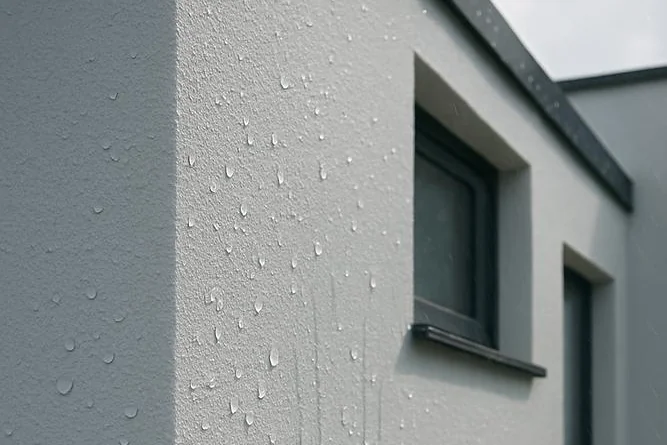
In Southeast Asia’s tropical climate—particularly in Thailand—monsoon rainfall and extreme humidity are the ultimate enemies of exterior building facades. Newly constructed high-rises, commercial centers, and luxury residences look pristine upon handover, but often deteriorate after just a few rainy seasons. Facades quickly develop dark water streaks, efflorescence, mold, and unsightly algae along window sills, parapets, and structural joints.
Beyond ruining architectural aesthetics and eroding property value, moisture penetrating deep into masonry degrades concrete structures, breaks mortar bonds, and corrodes internal steel rebar—compromising long-term structural integrity. Repainting with standard chemical paints every 3 to 5 years creates a costly, repetitive maintenance cycle.
For architects aiming to preserve timeless architectural design and property owners seeking long-term value, specifying materials with advanced water and moisture management is critical. Pure silicate mineral paint acts as an eco-friendly, mineral-based shield designed specifically to withstand harsh tropical conditions.
Decoding the Root Cause: Why Rain and Pollution Cause Persistent Facade Staining
To solve dirt streaking and water damage permanently, we must understand the chemical and physical limitations of traditional synthetic (acrylic) exterior paints under intense tropical weather.
1. Thermoplasticity and Static Charge
Standard commercial acrylic paints rely on synthetic petrochemical polymers, using acrylic resin as a binder. When applied, acrylic paint cures into a flexible, rubbery plastic film over the concrete. However, this polymer structure is thermoplastic (sensitive to heat):
Heat Softening: Under direct sunlight, exterior wall temperatures frequently exceed 40–50°C. High heat softens the plastic paint film, creating a tacky surface.
Static Charge: Air friction across the plastic film generates static electricity. Airborne dust, vehicle exhaust particles, and industrial pollutants are electrostatically pulled to the wall, locking into the heat-softened plastic film even before the rain falls.
2. Dirt Streaking and “Tear Stains”
During the monsoon season, rainwater dissolves dust, soot, and atmospheric grime accumulated on roofs, window ledges, and copings, washing it vertically down the facade.
Because standard acrylic paint films are superficially hydrophobic, water droplets carrying suspended dirt evaporate under the sun, leaving deep-seated grime tracks behind. Known in architecture as dirt streaking or tear staining, these dark lines become permanently baked into the synthetic plastic layer and are extremely difficult to clean.
3. Moisture Trapping and Efflorescence
Concrete is naturally porous and rich in calcium compounds. When rainwater leaks through micro-cracks into a wall coated with acrylic paint, the non-porous plastic film blocks natural evaporation. Trapped water dissolves mineral salts within the concrete structure.
Hydrostatic pressure forces this mineral solution to the surface through the paint layer. Upon contact with atmospheric carbon dioxide, it crystallizes into chalky white deposits called efflorescence, destroying the paint bond and ruining the finish.
The Intelligent Mechanism of Pure Silicate Mineral Paint
Pure silicate paint transforms wall protection by replacing soft, sticky plastic films with an inorganic mineral system that fuses directly with the masonry substrate through three core engineering mechanisms:
1. Micro-Porous & Breathable Technology
Pure silicate paint undergoes silification—a chemical reaction that permanently fuses the potassium silicate binder with the concrete substrate, forming a micro-porous structure:
Blocks Liquid Water (Hydrophobic): The surface pore structure features high surface tension, making the openings too small for liquid rain droplets to penetrate. Rainwater beads up and rolls off immediately.
Vapor Permeable (Breathable): Conversely, the open micro-pores are large enough to allow interior water vapor molecules to evaporate freely. With an equivalent air layer thickness ($S_d$-value) below 0.02 meters, it meets the highest international breathability standards.
By keeping the wall structure dry internally, hydrostatic pressure cannot build up—permanently preventing paint blistering, efflorescence, and sub-surface black mold growth.
2. Anti-Static Neutral Surface
Formulated from potassium liquid glass and natural mineral pigments, pure silicate paint creates a non-chargeable, stone-like inorganic surface. It generates zero static electricity and will not soften or become sticky under intense heat. Atmospheric dust and pollution sit loosely on the surface without bonding to the finish.
3. Natural Self-Cleaning Effect
Because grime cannot lock into the rigid mineral structure, rainfall acts as a natural wash-off mechanism. Stormwater rinsing down the facade effortlessly flushes away loose dust particles without leaving dirt streaks or water tracks. The building remains clean, crisp, and freshly painted after every rainfall.
Material Comparison: Synthetic Acrylic vs. Pure Silicate Paint
| Performance Characteristic | Standard Acrylic Paint | Pure Silicate Mineral Paint |
| High Heat Surface Behavior | Softens and becomes sticky (Thermoplastic) | Remains rigid stone; non-tacky |
| Static Electricity Generation | High (Attracts and embeds dust/soot) | Zero static charge (Dust sits loosely) |
| Rainwater Reaction | Grime dries into film (Causes tear stains) | Rain rinses dirt off naturally (Self-cleaning) |
| Moisture Management | Traps moisture (Triggers efflorescence) | Fully breathable ($S_d < 0.02\text{ m}$); wall stays dry |
| Facade Lifespan | 5–10 years (Requires frequent washing/repainting) | 20–50+ years (Decades of colorfast durability) |
| Environmental Footprint | Emits VOCs; breaks down into microplastics | Zero VOCs; 100% natural inorganic mineral dust |
Strategic Advantages for Sustainable Architectural Design
Specifying natural mineral-based paints delivers major advantages for building engineering, design integrity, and long-term facility management:
Timeless Facade Aesthetics: Prevents the rapid staining that often degrades modern, minimalist white or earth-toned facades within 1 to 2 years, preserving clean architectural lines and true color tones for decades.
Minimal Lifecycle & Facility Maintenance Costs: Eliminates the need for frequent, high-cost pressure washing or repainting projects involving rappelling teams (spidermans), scaffolding, or boom lifts.
Concrete & Structural Protection: Keeping the concrete dry prevents carbonation—the process where concrete loses alkalinity, leading to internal rebar corrosion, rusting, expansion, and structural spalling.
Zero Microplastic Environmental Impact: Flaking acrylic paint releases synthetic polymers into local soil and waterways as microplastic pollution. Silicate mineral paint slowly degrades into non-toxic silica mineral dust, earning top credits under LEED and TREES green building rating systems.
Specification & Application Guidelines for Architects and Builders
To maximize the performance of pure silicate paint on site, follow these core surface preparation standards:
New Concrete & Plaster: Silicate paints require calcium in the masonry substrate for silification. Ensure surfaces are clean, free of form-work release agents, grease, and dust. Hairline cracks should be repaired using inorganic mineral fillers to maintain system breathability.
Renovation over Old Acrylic Coatings: When repainting over existing synthetic paints, the old acrylic film should be stripped. Alternatively, specify a Sol-Silicate paint system—an advanced mineral formula designed to bond chemically to both raw masonry and existing organic paint surfaces.
Appreciating the Mineral Aesthetic: Pure silicate paint cures into a natural, ultra-flat matt finish. Slight tonal variations (cloud effect) may appear during drying due to subtle moisture differences in the plaster. This dynamic, natural patina is a hallmark of authentic mineral architecture, distinct from the flat, synthetic look of plastic coatings.
Conclusion
Protecting building facades from rain stains and moisture through pure silicate mineral paint proves that working alongside natural material science yields far superior, sustainable results than applying synthetic chemical coatings.
For Architects: Silicate paint offers an advanced surface engineering solution that preserves design clarity, prevents dirt streaking, eliminates static charge, and contributes directly to international green building certifications.
For Homeowners & Developers: It represents a high-value, long-term investment in building preservation—keeping structures dry, clean, and pristine for decades without the headache of peeling paint or water stains.